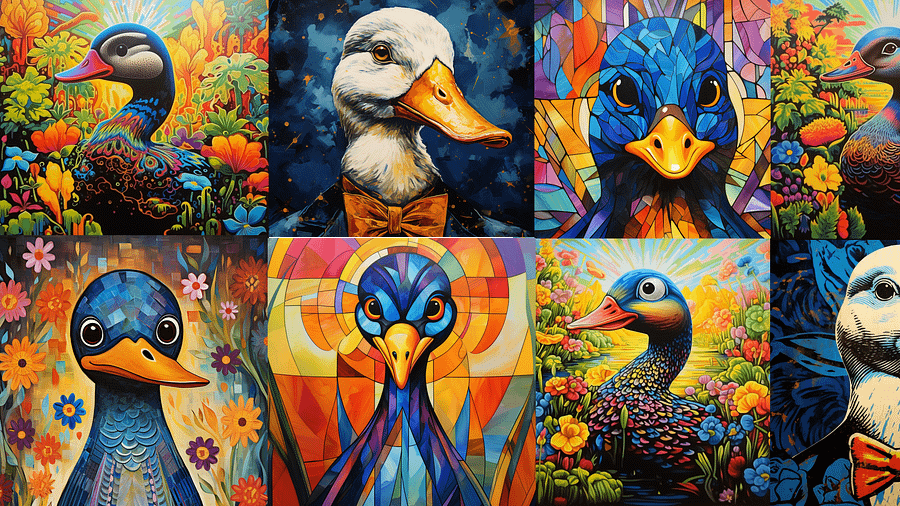
In the dynamic world of digital art, artificial intelligence is playing an increasingly visible role. I set up a simple MidJourney experiment: the constant was a duck; the variables were style, detail, color, and composition.
The daily duck challenge
Each day, I asked MidJourney to create a duck influenced by a different artist with a distinct visual language. The sequence explored references including Shepard Fairey, Salvador Dalí, and Aries Moross. After the first composition was rendered, I introduced one variable at a time—landscape direction, greater detail, color changes, or a shift in style. I limited myself to five versions in the attempt to reach the strongest result.
The artistic outcome
The results were striking. The model could produce substantial variation while keeping the same basic subject, and some of the unexpected turns were more interesting than the first idea. One Aries Moross-inspired variation in particular felt like discovering a small visual surprise rather than simply receiving an output.
Reflections on AI and art
So what does that mean for creative work? I do not see a tool like MidJourney as an automatic artwork machine. Strong results still depend on the idea, the prompt, selection, iteration, and a designer's judgment about what is worth keeping. The software cannot decide what the project should mean, who it is for, or when a result is actually good enough.
Looking ahead
AI will continue to influence how images are explored and produced, but the more useful question is how it can extend—not replace—creative judgment. As with any tool, the process matters: deciding what to ask, recognizing what works, rejecting what does not, and shaping the result toward a purpose.